
Brush heads for sonic toothbrushes: what you really need to know – and when you should replace them
You brush twice a day. You use a sonic toothbrush. But when did you last replace your brush head? Science shows: worn bristles clean significantly worse – and no one notices until it's too late. This article explains what really happens in the brush head, which bristles are better for your gums, and why replacing it at the right time
The invisible loss of quality: what happens to your brush head
Imagine driving a car whose tires are slowly losing tread – so slowly that you'd overlook it every day. The braking performance decreases, but you don't notice because it happens gradually.
It's similar with your brush head. Every time you brush, you bend the bristles, scrape them over tooth surfaces and press them into the gum margin. After weeks of use, they change shape: they splay outward, bend permanently, lose their even alignment. In dentistry, this is called bristle splaying – or in English: bristle splaying.
The decisive finding comes from Rosema et al. (2018), who demonstrated in a study with 172 participants: Toothbrushes with extreme bristle splaying remove plaque significantly worse than new or only lightly used brushes (plaque index 1.98 vs. 1.71; p = 0.01).[1] Anyone who brushes with the same brush head for too long thinks they're cleaning – but in reality is only cleaning half-heartedly.

New
Optimal
Bristles straight, evenly aligned. Maximum cleaning performance.
Plaque index 1.71
Lightly used
Still effective
Minimal splaying. Cleaning performance barely affected.
Grade 2 (Rosema)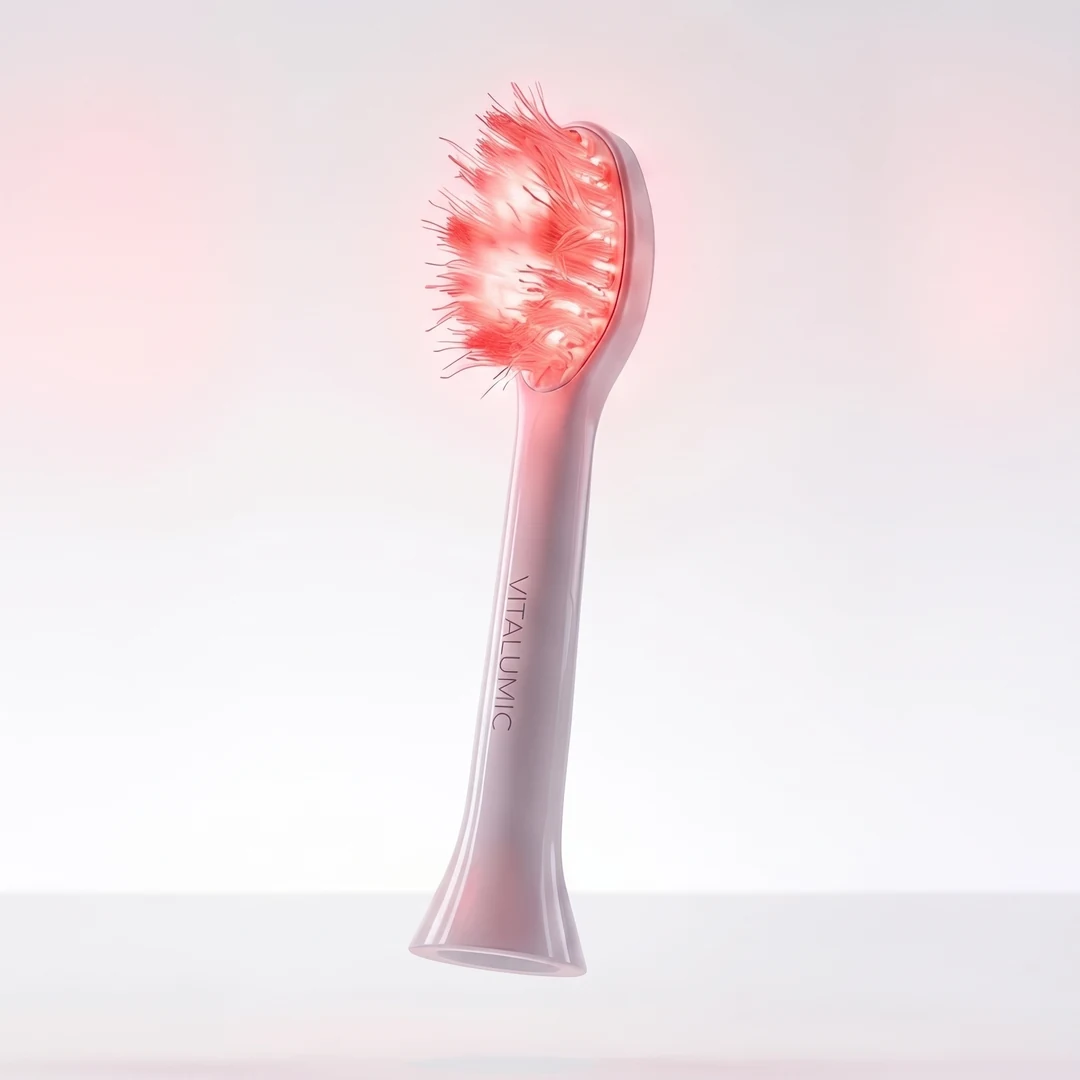
Moderately worn
Replace soon
Visible splaying. Cleaning decreases measurably. Replace soon.
Grade 3 (Rosema)
Extreme — replace now!
Replace immediately
Outer bristles over the edge of the head. Cleaning significantly worse. Replacement overdue.
Plaque index 1.98The irony: those who brush diligently and vigorously wear out their brush head faster than someone who brushes gently. Same brushing time, a completely different hygiene effect – depending on the condition of the bristles.
When is it time for a new brush head?
The The American Dental Association (ADA) recommends replacing an electric brush head every three months .[2] Manufacturer recommendations from Philips Sonicare or Oral-B follow the same rule of thumb.
But "every three months" isn't science set in stone. Rosema et al. (2018) show: Bristle wear varies considerably between people. Those who press harder or brush more often reach the critical wear point sooner.[1] So the question isn't just "How old is my brush head?" – but: "What do my bristles look like?"
The two signals to watch for
1. Visible bristle splaying
Hold your brush head at an angle against the light. Are the outer bristle tufts pointing outward instead of straight up? Have bristles bent permanently? That's the most reliable sign: It's time for a change. In the Rosema study, splaying grade 4 defines outer bristle tufts that splay beyond the edge of the brush head – a directly visible condition.[1]
2. Faded color indicator
Many modern brush heads – including the DualWave heads for the Vitalumic – have colored indicator bristles. These bristles are designed so that the dye at the bristle tip wears off evenly while brushing. When the colored bristles are noticeably lighter or faded halfway: time to replace.[3]
Important note: the color indicator is a practical signal, but not a clinically validated instrument. It gives you a guideline – but doesn't replace visually checking the actual bristle shape.
Why bristle stiffness matters more than you think
It's not just wear that matters. The stiffness of the bristles from the start has a direct impact on your gums. A systematic review by Ranzan, Muniz and Rösing (2019), which analyzed 13 controlled clinical studies, comes to a clear conclusion:[4]
Hard bristles produce significantly more gum injuries than medium or soft bristles.
Ranzan, Muniz & Rösing (2019), International Dental Journal
In one of the analyzed studies – a randomized controlled trial with 120 participants over 8 weeks – the following emerged:
| Bristle stiffness | Gum injuries after 8 weeks |
|---|---|
| Hard | 20 injuries |
| Medium | 6 injuries |
| Soft | 2 injuries |
In other words: Anyone who brushes hard or uses hard bristles systematically damages their gums – and keeps giving the biofilm new niches to settle in. With sonic toothbrushes, the high-frequency vibration does the mechanical cleaning work. You don't need to press – and you should avoid hard bristles. Soft material reliably protects the tissue.[4]
Bristle shape: why the tip of the bristles matters
Not all bristles are the same. In manufacturing, two basic end shapes are distinguished:
End-rounded bristles
The bristle tip is mechanically rounded (end-rounded) – a processing technique that prevents sharp plastic edges from microscopically tearing the gums. Standard on high-quality brush heads.
Tapered bristles
The bristle tapers toward the tip (tapered) – naturally pointed. The review by Ranzan et al. (2019) shows: Both shapes have comparably safe profiles.[4] Stiffness matters – not the end shape.
In practice: a brush head with soft, end-rounded bristles is a good choice. The Vitalumic DualWave brush heads are made with original DuPont™ Tynex® bristles – nylon filaments considered the industry standard for toothbrush bristles and optimized for controlled stiffness with minimal tissue wear.
How sonic toothbrushes clean – and what happens beyond the bristle tips
A sonic toothbrush isn't a faster manual toothbrush. It works on a different physical principle. When a sonic toothbrush vibrates at a typical 270–350 Hz , the surrounding saliva film produces hydrodynamic forces – pressure waves that can loosen bacterial colonies that the bristles themselves don't even touch directly.
Stanford University (1997): The sonic toothbrush removed in vivo-formed plaque even at a distance of 3 mm beyond the bristle tips – with an effectiveness of 56 to 78 percent (p < 0.001). A conventional electric toothbrush had at the same distance no effect at all.[5]
For your brush head, this has a direct consequence: these hydrodynamic forces depend on an intact, evenly vibrating bristle geometry . When the bristles splay, the vibration profile changes – and with it this cleaning effect in the gum margin. So a worn brush head doesn't just lose its mechanical cleaning advantage – it also loses the extra hydrodynamic effect exactly where it would matter most: at the border zone between tooth and gum.
Sonic vs. oscillating-rotating: what does research show?
In dentistry, two main technologies compete:
| Criterion | Sonic (e.g. Vitalumic DualWave) | Oscillating-rotating (e.g. Oral-B) |
|---|---|---|
| Frequency / principle of action | 250–350 Hz, hydrodynamic forces | Alternating rotation + pulse, mechanical contact |
| Interproximal plaque (short-term) | 61% whole-mouth reduction[6] | 88% whole-mouth reduction[6] |
| Hydrodynamic subgingival effect | up to 3 mm beyond the bristles[5] | — |
| Integration of light therapy (660 nm / NIR) | Possible thanks to transparent head | — |
| Superiority vs. manual toothbrush | Yes (scientific consensus)[7] | Yes (scientific consensus)[7] |
A 2024 systematic review (Lewis et al., 17 randomized studies) confirmed: oscillating-rotating heads remove more interproximal plaque in the short term.[7] The catch: Short-term studies only measure what is measurable directly after a single brushing. They don't capture the hydrodynamic cleaning effect of the sonic brush, long-term tissue compatibility, or the integration of additional technologies like red light therapy.
Both electric technologies are superior to manual toothbrushes in plaque reduction – that's scientific consensus.[7] Choosing between them is often a matter of personal preference for comfort – and additional levels of action.
What makes a good brush head for sonic toothbrushes
Not every brush head is the same. Here are the decisive criteria to judge by:
1. Bristle stiffness
Soft bristles are clinically safer and are gentle on the gums.[4] With proper brushing technique, no loss of cleaning – but demonstrably less tissue damage. For sonic toothbrushes, which clean through frequency instead of pressure, soft bristles are the standard.
2. Bristle material
High-quality brush heads use plastic bristles with defined mechanical properties. The Vitalumic DualWave heads are made with original DuPont™ Tynex® bristles – nylon filaments optimized for controlled stiffness with minimal tissue wear.
3. Brush head size
Smaller brush heads reach molars and the backs of the rear teeth better. For people whose main problems lie in the gum margin of the back teeth, a compact head is often superior.
4. Transparency of the head
For sonic toothbrushes with integrated LED, the transparency of the brush head is crucial. Only a semi-transparent base lets the light reach the gum margin. An opaque third-party head blocks the light completely.
Why the brush head does more on the Vitalumic DualWave than elsewhere
Most brush heads solve one task: removing biofilm mechanically. The DualWave brush head is designed as a combination interface – it solves two tasks at the same time.
Task 1 — mechanics + hydrodynamics
Soft bristles for tissue protection. 80,000 vibrations per minute create hydrodynamic forces in the gum margin.[5] Four selectable modes from gentle to intensive for different needs.
"Red light works through photobiomodulation. It can promote blood circulation in the gums, modulate inflammatory processes and support cell regeneration. This can be useful as a complementary measure for sensitive or inflamed gums."
Dr. Karoline Waubke, dental practice in Munich – quoted in Vogue Germany, 2026[10]
The combination of sonic cleaning and red light follows a biologically grounded logic: The bristles clean the tooth surface. The brush head guides the light. The light strengthens the tissue behind it.
Three rules for taking care of your brush head
Replace based on appearance – not the calendar
The ADA recommends every three months.[2] Those who press harder reach the critical wear point sooner.[1] Check your bristles monthly: are they splaying? Have the indicator bristles faded? Also check whether the size of the brush head suits your anatomy – compact heads are often the better choice for back molars.
No pressure – let the frequency do the work
Sonic toothbrushes clean through frequency and flow forces, not through mechanical pressure.[5] Pressing wears the bristles out faster and switches off the hydrodynamic effect. The hand only guides – the device cleans. Light contact is enough.
Only use compatible heads for light transmission
If your toothbrush has an integrated LED, the brush heads must be specified for that model. An opaque third-party brush head blocks the light completely – you're then brushing without using your device's primary distinguishing channel of action.
The DualWave brush head: two channels of action. One routine step.
- Soft DuPont™ Tynex® bristles — clinically tested, gentle on tissue
- 80,000 vibrations per minute — hydrodynamic cleaning effect up to 3 mm
- Semi-transparent base — guides 660 nm red light onto the gum margin
- Colored indicator bristles — visual replacement signal, no guesswork
- Compatible with standard and compact sizes
Individual results may vary. This article is for information and does not replace dental advice.
Key takeaways
A brush head isn't an accessory you forget about. It's the interface between your device and your mouth – and its condition directly determines how well your dental care routine works. The science is clear:
- Worn bristles demonstrably clean worse – and no one notices the transition.[1]
- Hard bristles damage the gums – consistently, over weeks and months.[4]
- The hydrodynamic effect of the sonic toothbrush depends on intact bristle geometry – worn heads switch it off.[5]
- The size of the brush head determines whether you reach all tooth surfaces – compact heads are often superior for back molars.
- If the brush head acts as a light guide for red light therapy , the right, compatible and promptly replaced head is the prerequisite for your device to deliver what it was designed for.
Every three months. Or sooner, if the bristles say so.
Sources
- Rosema, N., Hennequin-Hoenderdos, N. L., Versteeg, P. A., van Palenstein Helderman, W. H. & van der Weijden, G. A. (2018). Toothbrush wear in relation to toothbrushing effectiveness. International Journal of Dental Hygiene, 17(1), 77–84. DOI: 10.1111/idh.12370. PMID: 30326176.
- American Dental Association (ADA). Toothbrush replacement. Recommends replacement every 3–4 months. ada.org
- Philips Sonicare. When should I replace my Sonicare brush head? Indicator bristle guidance: replace when faded to halfway. philips.com
- Ranzan, N., Muniz, F. W. M. G. & Rösing, C. K. (2019). Are bristle stiffness and bristle end-shape related to adverse effects on soft tissues during toothbrushing? A systematic review. International Dental Journal, 69(3), 171–182. DOI: 10.1111/idj.12421. PMID: 30152076.
- Stanford, C. M., Srikantha, R. & Wu, C. D. (1997). Efficacy of the Sonicare toothbrush fluid dynamic action on removal of human supragingival plaque. The Journal of Clinical Dentistry, 8(1 Spec No), 10–14. PMID: 9487839.
- Strate, J., Rolla, G. & Assev, S. (2005). A comparison of the efficacy of power and manual toothbrushes in plaque removal after a single brushing. International Dental Journal, 55(4), 227–232. DOI: 10.1111/j.1875-595x.2005.tb00312.x. PMID: 15997965.
- Lewis, R. D., Kanagasingam, S., Cook, N., Krysmann, M., Taylor, K. & Pisani, F. (2024). The Effect of Different Electric Toothbrush Technologies on Interdental Plaque Removal: A Systematic Review with a Meta-Analysis. Healthcare (Basel), 12(10), 1035. DOI: 10.3390/healthcare12101035. PMC: PMC11121692.
- Hamblin, M. R. (2017). Mechanisms and applications of the anti-inflammatory effects of photobiomodulation. AIMS Biophysics, 4(3), 337–361. DOI: 10.3934/biophy.2017.3.337.
- Kocherova, I. et al. (2021). Photobiomodulation with Red and Near-Infrared Light Improves Viability and Modulates Expression of Mesenchymal and Apoptotic-Related Markers in Human Gingival Fibroblasts. Materials (Basel), 14, 3427. DOI: 10.3390/ma14123427. PMID: 34205573.
- Oostland, D. Are red light toothbrushes the new wellness upgrade for your gums? Vogue Germany, 2026. Expert statement: Dr. Karoline Waubke, dental practice in Munich. vogue.de
This article is for general information and does not replace a dental diagnosis or treatment. If you have existing complaints – especially bleeding gums, pain or diagnosed periodontitis – please see a dentist. Individual results may vary.